Consider the matrix \(A = \begin{bmatrix} 2 & 1 \\ c & 6 \end{bmatrix}\), where \(c \in \mathbb{R}\) is some constant.
Each part asks you to find the values of \(c\), \(\lambda_1\) (\(A\)’s larger eigenvalue) and \(\lambda_2\) (\(A\)’s smaller eigenvalue) given the information provided. Your answers should be numbers with no variables.
If \(A\) only has one unique eigenvalue, put the same number for both \(\lambda_1\) and \(\lambda_2\).
Hint: Remember the relationship between the eigenvalues of a matrix and its determinant and trace.
If \(A\) is not invertible, then \(\det(A)=0\). Here,
$$ \det(A) = (2)(6) - (1)(c) = 12 - c $$
so
$$ 12 - c = 0 \implies \boxed{c = 12} $$
The trace is
$$ \text{tr}(A)=2+6=8 $$
so the eigenvalues must add to 8. Since the determinant is 0, the eigenvalues must multiply to 0, so one eigenvalue is 0 and the other is 8. Therefore,
A \(2 \times 2\) matrix is not diagonalizable only if it has an eigenvalue \(\lambda\) with algebraic multiplicity 2 but geometric multiplicity 1, i.e. a repeated eigenvalue but only one linearly independent eigenvector. Since the two eigenvalues must add to 8, they must both be
$$ \lambda = \frac{8}{2} = 4 $$
$$ \boxed{\lambda_1 = 4, \qquad \lambda_2 = 4} $$
That means the determinant must be
$$ 4 \cdot 4 = 16 $$
So,
$$ 12 - c = 16 \implies \boxed{c = -4} $$
Make sure to place the larger eigenvalue in \(\lambda_1\) and the smaller eigenvalue in \(\lambda_2\)!
Consider the adjacency matrix \(A = \begin{bmatrix} 0.4 & 0 & 0.5 \\ 0.4 & 0 & 0.5 \\ a & b & c \end{bmatrix}\) for a Markov chain with three states, where \(a, b, c \in \mathbb{R}\) are some constants.
a)
6 pts Find \(a\), \(b\), and \(c\) such that \(A\) is a valid adjacency matrix. Give your answers as numbers with no variables.
\(a = \_\_\_\_\_\_, \qquad b = \_\_\_\_\_\_, \qquad c = \_\_\_\_\_\_\)
Solution
For a valid adjacency matrix, each column must sum to 1, since the columns describe the transition probabilities out of a given state. So,
$$ \begin{align*} 0.4 + 0.4 + a &= 1 \implies a = 0.2 \\\\ 0 + 0 + b &= 1 \implies b = 1 \\\\ 0.5 + 0.5 + c &= 1 \implies c = 0 \end{align*} $$
Therefore,
$$ \boxed{a = 0.2, \qquad b = 1, \qquad c = 0} $$
b)
6 pts Suppose \(\vec x^{\ast} \in \mathbb{R}^3\) is a vector containing the long-run fraction of time spent in each state. Which of the following vectors is \(\vec x^{\ast}\) and why?
Let \(A\) be a \(4 \times 4\)symmetric matrix with eigenvalue decomposition \(A = V \Lambda V^{-1}\). Suppose the columns of \(V\) are \(\vec v_1\), \(\vec v_2\), \(\vec v_3\), and \(\vec v_4\), in that order, and that the columns of \(V\) are unit vectors.
True or False: \(V\) is guaranteed to be an orthogonal matrix.
True False
Solution
True False
This is true. Since \(A\) is symmetric, the spectral theorem states that eigenvectors corresponding to different eigenvalues are automatically orthogonal. Additionally, \(A\) has four unique eigenvalues. This means that the columns of \(V\) are guaranteed to be orthogonal. Since we’re told that the columns of \(V\) are unit vectors, they are orthonormal, so \(V\) is orthogonal.
True or False: \(V\) is guaranteed to be an orthogonal matrix.
True False
Solution
True False
This is false. A symmetric matrix always has an orthonormal eigenbasis, but when an eigenvalue is repeated, the problem does not guarantee that the particular unit eigenvectors in \(V\) were chosen to be orthogonal within that eigenspace. The two eigenvectors corresponding to \(\lambda = 2\) are guaranteed to be orthogonal to the eigenvectors for \(\lambda = 1\) and \(\lambda = 4\), but not necessarily orthogonal to each other.
The rest of this problem does not use any of the information from parts a) and b). Suppose \(k\) is some positive integer greater than 1, and that
6 pts What is the value of \(k\)? Select one of the answers below, then justify your answer in the box provided. Hint: If \(A = V \Lambda V^{-1}\), what is \(A^k\)?
Among the answer choices, the only value of \(k\) for which all three numbers are perfect \(k\)th powers is \(k=3\):
$$ 8 = 2^3 \qquad 27 = 3^3 \qquad 64 = 4^3 $$
Therefore, \(\boxed{k = 3}\).
d)
2 pts Fill in the blank: as \(k \to \infty\), the direction of \(A^k \vec x\) approaches the direction of...
\(\vec v_1\)\(\vec v_2\)\(\vec v_3\)\(\vec v_4\)
Solution
\(\vec v_1\)\(\vec v_2\)\(\vec v_3\)\(\vec v_4\)
From part c), the relevant eigenvalues have magnitudes 2, 3, 0, and 4. As \(k \to \infty\), the component corresponding to the largest eigenvalue magnitude dominates, so the direction of \(A^k \vec x\) approaches the direction of \(\boxed{\vec v_4}\).
$$ A = \begin{bmatrix} 3 & 2 \\\\ k & 4 \end{bmatrix} $$
In each part, you are provided with information about \(A\). Your job is to find the value of \(k\) that satisfies the given condition. Show your work in the space provided, and write your final answer in the bottom-right corner of the box. Your answers should be numbers with no variables.
a)
4 pts\(\text{rank}(A) = 1\)
$$ k = \_\_\_\_\_\_ $$
Solution
If \(\text{rank}(A) = 1\), then \(A\) is not invertible, which means \(\text{det}(A) = 0\). So,
The inverse of a \(2 \times 2\) matrix \(\begin{bmatrix} a & b \\ c & d \end{bmatrix}\) is \(\frac{1}{ad - bc} \begin{bmatrix} d & -b \\ -c & a \end{bmatrix}\). So,
Consider the matrix \(A = \begin{bmatrix} 2 & 3 \\ -4 & k \end{bmatrix}\) where \(k \in \mathbb{R}\) is some unknown constant.
a)
3 pts Suppose \(\lambda_1 = 0\) is an eigenvalue of \(A\). Find the value of \(k\). Give your answer as a number with no variables.
\(k = \_\_\_\_\_\_\)
Solution
If \(0\) is an eigenvalue, then \(\det(A)=0\). So
$$ \det(A)=2k-3(-4)=2k+12=0 $$
This gives
$$ k=\boxed{-6} $$
b)
4 pts Suppose \(\begin{bmatrix} 1 \\ 1 \end{bmatrix}\) is an eigenvector of \(A\). Find the value of \(k\). Give your answer as a number with no variables.
$$ k = \_\_\_\_\_\_ $$
Solution
If \(\begin{bmatrix}1\\1\end{bmatrix}\) is an eigenvector, then
must be a scalar multiple of \(\begin{bmatrix}1\\1\end{bmatrix}\). Therefore,
$$ k-4=5 $$
so
$$ k=\boxed{9} $$
c)
5 pts Suppose \(\lambda_1 = 3\) is an eigenvalue of \(A\). Find \(\lambda_2\), the other eigenvalue of \(A\). Show your work, and write your final answer in the box provided. Give your answer as a number with no variables.
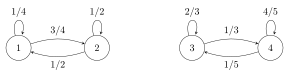
The state diagram below describes a Markov chain with four states.
a)
4 pts Find the adjacency matrix \(A\) for this Markov chain.
\(A =\) ______
Solution
Column \(j\) contains the probabilities of transitioning from state \(j\) to all other states; columns must sum to \(1\). Reading from the diagram, the first two columns come from the left “connected component” (made up of states \(1\) and \(2\)), and the last two columns come from the right connected component. So
6 pts Suppose the chain starts in state \(\mathbf{1}\). Fill each box with the long-run fraction of time spent in each state. Your answers should be numbers with no variables, and should sum to \(1\).
State 1: ______ State 2: ______ State 3: ______ State 4: ______
Solution
As we know from Chapter 9.3, the long-run fraction of time spent in each state is described by the eigenvector of the adjacency matrix corresponding to eigenvalue \(1\) (and whose components sum to \(1\)).
What is tricky about this particular adjacency matrix is that it has two linearly independent eigenvectors, both for the eigenvalue \(1\). Why? Note that the Markov chain has two isolated islands, and its impossible to transition between them. So if we ever start in states \(1\) or \(2\), in the long run, we will only spend time in states \(1\) and \(2\). Similarly, if we start in states \(3\) or \(4\), in the long run, we will only spend time in states \(3\) and \(4\).
This means that we can simplify the problem by just looking at the \(2 \times 2\) matrix in the top right of \(A\) corresponding to the left island (states \(1\) and \(2\)). This matrix is
All we need to do now is find the eigenvector of \(A_{\text{left}}\) corresponding to eigenvalue \(1\). If such an eigenvector is of the form \(\begin{bmatrix} a \\ b \end{bmatrix}\), then
$$ \begin{bmatrix} 1/4 & 1/2 \\\\ 3/4 & 1/2 \end{bmatrix} \begin{bmatrix} a \\\\ b \end{bmatrix} = 1 \begin{bmatrix} a \\\\ b \end{bmatrix} $$
The first row gives us
$$ \frac{1}{4}a + \frac{1}{2} b = a \implies \frac{1}{2} b = \frac{3}{4}a \implies b = \frac{3}{2}a $$
So, if \(a = 2\), then \(b = 3\). But, the steady-state distribution must have components that sum to \(1\), so as probabilities, we’re looking at \(2/5\) and \(3/5\).
Not only is \(\begin{bmatrix} 2/5 \\ 3/5 \end{bmatrix}\) an eigenvector of \(A_{\text{left}}\) corresponding to eigenvalue \(1\), but
is an eigenvector of the full matrix \(A\) corresponding to eigenvalue \(1\)! The 0’s in the latter two components effectively “ignore” states \(3\) and \(4\), representing the assumption that we start in state \(1\).
There’s a section in Chapter 9.4 about block diagonal matrices that is relevant here.
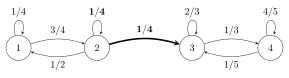
Now, consider a modified version of the Markov chain. Changes have been emphasized in bold.
c)
4 pts Consider the statement: “‘If we start in ____, the long-run fraction of time spent in each state is the same as in the original chain.’’
Which of the following could be placed in the blank to make the statement true? Select all that apply.
state 1 state 2 state 3 state 4 none of these are valid
Solution
state 1 state 2 state 3 state 4 none of these are valid
In the modified chain, starting in state \(1\) or state \(2\) eventually leads to the right connected component, because there is now a positive-probability path from state \(2\) to state \(3\). This changes the long-run fractions compared to the original chain. The long-run fraction of time spent in states \(1\) and \(2\) now will be \(0\).
Starting in state \(3\) or state \(4\), the chain stays in the right connected component, and that component has not changed. There is no way to go from state \(3\) to \(2\) or \(1\). So, the long-run fractions are the same as in the original chain; \(3/8\) for state \(3\) and \(5/8\) for state \(4\), and \(0\) for states \(1\) and \(2\).
Let \(S\) be a \(3 \times 3\)symmetric matrix with eigenvectors \(\vec v_1\), \(\vec v_2\), and \(\vec v_3\) corresponding to eigenvalues \(5\), \(2\), and \(-1\), respectively. Assume that each \(\vec v_i\) is a unit vector.
Suppose \(\vec x \in \mathbb{R}^3\) and that
$$ \vec x = 3\vec v_1 - 4\vec v_2 + \vec v_3 $$
a)
6 pts Write \(S^2 \vec x\) as a linear combination of \(\vec v_1\), \(\vec v_2\), and \(\vec v_3\). Fill in each box with a number with no variables.
This result doesn’t rely on the fact that \(\vec v_1\), \(\vec v_2\), and \(\vec v_3\) are unit vectors or orthogonal; we’ll use these assumptions in the next part.
b)
4 pts What is the value of \(\lVert S\vec x \rVert^2\)?
\(24\)\(26\)\(218\)\(290\)\(5882\) Not enough information
Solution
\(24\)\(26\)\(218\)\(290\)\(5882\) Not enough information
Applying \(S\) once gives
$$ S\vec x = 15\vec v_1 - 8\vec v_2 - \vec v_3 $$
Since \(S\) is symmetric, eigenvectors corresponding to distinct eigenvalues are orthogonal. The vectors \(\vec v_1\), \(\vec v_2\), and \(\vec v_3\) are also unit vectors, so
Yet another way to look at this is to see that \(S = Q \Lambda Q^T\), where the columns of \(Q\) are the vectors \(\vec v_i\) and the diagonal entries of \(\Lambda\) are \(5\), \(2\), and \(-1\). So,
In this solution, we used the fact that \(\vec x = 3 \vec v_1 - 4 \vec v_2 + \vec v_3 = Q \begin{bmatrix} 3 \\ -4 \\ 1 \end{bmatrix}\), and since \(Q^T Q = I\) (if \(Q\)’s columns are the orthonormal \(\vec v_i\)’s), then \(Q^T \vec x = Q^TQ \begin{bmatrix} 3 \\ -4 \\ 1 \end{bmatrix} = \begin{bmatrix} 3 \\ -4 \\ 1 \end{bmatrix}\).
So the eigenvalues are \(6\) and \(-2\). Alternatively, using the trace and determinant facts from Chapter 9.1, you can arrive at this quickly by seeing that the eigenvalues must add to \(\text{trace}(A) = 2 + 2 = 4\) and multiply to \(\det(A) = 2 \cdot 2 - 4 \cdot 4 = -12\).
The top-left block has two linearly independent eigenvectors, \(\begin{bmatrix}1\\1\\0\end{bmatrix}\) and \(\begin{bmatrix}1\\-1\\0\end{bmatrix}\), with eigenvalues \(6\) and \(-2\), and \(\begin{bmatrix}0\\0\\1\end{bmatrix}\) is an eigenvector with eigenvalue \(k\). These three eigenvectors are linearly independent no matter what \(k\) is. Therefore \(B\) is diagonalizable for all integer values of \(k\).
Another way to think about this is that for any \(k\), the matrix \(B\) is symmetric, and hence diagonalizable, as told to us by the spectral theorem.
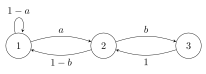
The state diagram below describes a Markov chain with three states. \(a\) and \(b\) are both constants between 0 and 1.
Suppose that in the long run, \(\displaystyle\frac{25}{60}\) of the time is spent in state 1, \(\displaystyle\frac{21}{60}\) of the time is spent in state 2, and \(\displaystyle\frac{14}{60}\) of the time is spent in state 3.
Find the values of \(a\) and \(b\). Show your work, and write your final answers in the boxes provided. Your answers should be numbers with no variables.
Solution
As discussed in Chapter 9.3, a steady-state distribution is an eigenvector of the adjacency matrix with eigenvalue \(1\), with the additional constraint that its entries sum to \(1\). We are given that the steady-state distribution is
$$ \vec x = \begin{bmatrix} 25/60\\\\ 21/60\\\\ 14/60 \end{bmatrix} $$
which already sums to \(1\). The adjacency matrix for this Markov chain is
$$ A= \begin{bmatrix} 1-a & 1-b & 0\\\\ a & 0 & 1\\\\ 0 & b & 0 \end{bmatrix} $$
So we need to choose \(a\) and \(b\) so that \(A\vec x=1\vec x=\vec x\). This gives
$$ \begin{bmatrix} 1-a & 1-b & 0\\\\ a & 0 & 1\\\\ 0 & b & 0 \end{bmatrix} \begin{bmatrix} 25/60\\\\ 21/60\\\\ 14/60 \end{bmatrix} = \begin{bmatrix} 25/60\\\\ 21/60\\\\ 14/60 \end{bmatrix} $$
Suppose \(A\) is a \(3 \times 3\) symmetric matrix with rank \(2\). The eigenspace corresponding to \(\lambda=9\) is the plane
$$ 2x-y+2z=0 $$
Suppose \(A=Q\Lambda Q^T\), where \(Q\) is an orthogonal matrix and \(\Lambda\) is a diagonal matrix with eigenvalues of \(A\) on the diagonal, sorted from largest to smallest.
a)
3 pts Find \(\Lambda\). Your answer should be a matrix with no variables.
$$ \Lambda = \_\_\_\_\_\_ $$
Solution
Since \(A\) is symmetric, the spectral theorem from Chapter 9.5 tells us that \(A\) is diagonalizable with orthogonal eigenspaces. The eigenspace for \(\lambda=9\) is a plane, so it is 2-dimensional. Since \(A\) has rank \(2\), it is not invertible, so it has at least one eigenvalue of \(0\). In fact, it has exactly one eigenvalue of \(0\), since the other two eigenvalues are both \(9\).
Since the eigenvalues are sorted from largest to smallest,
Find \(A\vec v\). Show your work, and write your final answer in the box provided. Your answer should be a vector with no variables. Hint: What does the spectral theorem tell us?
$$ A\vec v = \_\_\_\_\_\_ $$
Solution
The vector \(\begin{bmatrix}1\\2\\0\end{bmatrix}\) is in the eigenspace for \(\lambda=9\), since it satisfies the equation of the eigenspace, \(2x-y+2z=0\):
$$ 2(1)-2+2(0)=0 $$
This means \(\begin{bmatrix}1\\2\\0\end{bmatrix}\) is an eigenvector of \(A\) with eigenvalue \(9\).
The vector \(\begin{bmatrix}2\\-1\\2\end{bmatrix}\) is orthogonal to the plane \(2x-y+2z=0\) (conveniently, \(\begin{bmatrix} 2 \\ -1 \\ 2 \end{bmatrix}\) contains the coefficients of the plane equation, and the coefficients of the plane equation define a vector orthogonal to the plane). The spectral theorem tells us that this vector is in the eigenspace corresponding to \(\lambda=0\), because eigenvectors for different eigenvalues are orthogonal for symmetric matrices. Therefore,