This page is meant to give you quick access to problems and their solutions. Refer to the original exam PDF, linked above, for test-taking instructions and formatting. Note that we’ve kept the problem text identical, which is why you may see things like “write your answer in the box below” despite there not being a box on this page.
Suppose we’d like to find the optimal parameter, \(w^{\ast}\), for the constant model \(h(x_i)=w\), using the following dataset of \(n = 4\) values, \(y_1, y_2, y_3, y_4\):
$$ 0, \quad 2, \quad 4, \quad 20 $$
a)
3 pts First, suppose we find the optimal parameter by minimizing mean squared error, \(R_\text{sq}(w)\). Which value of \(w\) minimizes \(R_\text{sq}(w)\)? Give your answer as a number with no variables.
\(\text{minimizer of } R_\text{sq}(w) = \_\_\_\_\_\_\)
Solution
For the constant model, average squared loss is minimized at the mean of the \(y_i\)’s. Here,
For example, \(L_\text{clip}(10, 5) = 9\) and \(L_\text{clip}(5, 3) = 4\).
Let \(R_\text{clip}(w)\) be the average clipped loss for the constant model and this dataset.
b)
3 pts State one value of \(w\) where the derivative of \(R_\text{clip}(w)\) is not defined.
\(\text{one value of } w \text{ where the derivative of } R_\text{clip}(w) \text{ is not defined} =\) ______
Solution
The clipped loss changes formulas whenever
$$ (y_i-w)^2=9 $$
Equivalently, this happens when \(w=y_i\pm 3\). Since \(20-3=17\), one valid answer is \(\boxed{17}\).
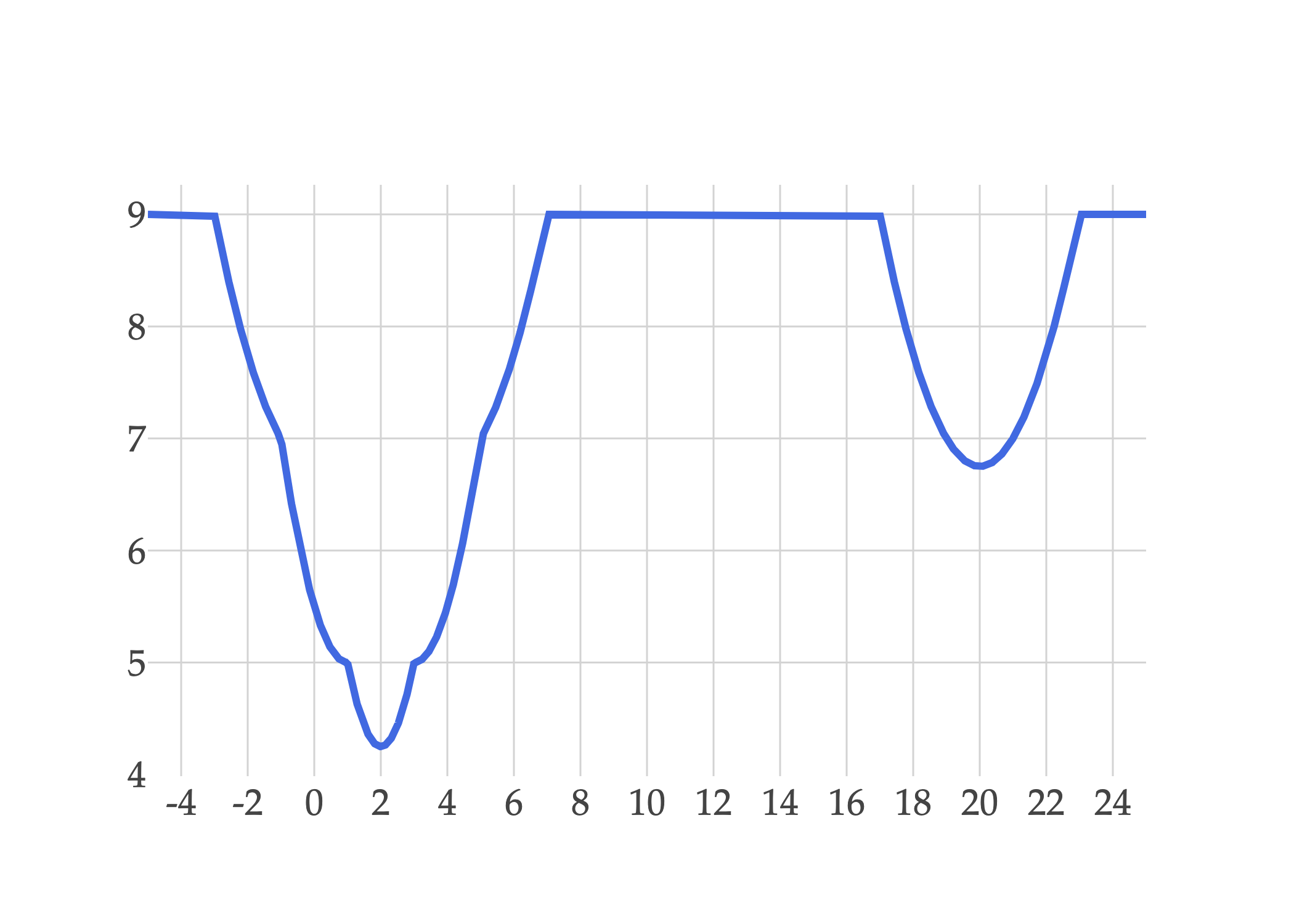
For context, here’s what average clipped loss looks like for this dataset:
c)
3 pts Suppose we restrict \(w\) to the interval \(1 \leq w \leq 3\). Among all values of \(w\) in this interval, which value minimizes \(R_\text{clip}(w)\)? Give your answer as a number with no variables.
\(\text{minimizer of } R_\text{clip}(w) \text{ within the interval } [1, 3] = \_\_\_\_\_\_\)
Solution
Once \(w\) is more than 3 units away from any particular \(y_i\) value, the value \((y_i - w)^2\) is replaced by the constant \(9\) when computing average loss.
What do we know about constants when they are added to functions? They don’t affect the minimizer! That is, the minimizer of \(f(x)\) and of \(f(x) + c\) are the same.
What this is saying is that if \(w\) is restricted to the interval \(1 \leq w \leq 3\), we can ignore \(y_4 = 20\) when computing the minimizer, and this just reduces to minimizing average squared loss (mean squared error) across the data points that are within 3 units of \(w\). As long as \(1 \leq w \leq 3\), we are within 3 units of \(y_1 = 0\), \(y_2 = 2\), and \(y_3 = 4\).
What constant minimizes average squared loss, for the dataset \(0, 2, 4\)? That’s the mean of \(0, 2, 4\), which is \(2\). So the minimizer of \(R_\text{clip}(w)\) within the interval \(1 \leq w \leq 3\) is \(\boxed{2}\).
If you’d like to see this a little more formally, then when \(1 \leq w \leq 3\),
Setting this equal to \(0\) gives \(w = 2\), as we intuited earlier.
d)
3 pts Now suppose there are no restrictions on \(w\). Among all possible values of \(w\), which value minimizes \(R_\text{clip}(w)\)? Give your answer as a number with no variables.
\(\text{minimizer of } R_\text{clip}(w) = \_\_\_\_\_\_\)
Solution
The best \(w\) is still \(w = 2\). As a refresher, let’s look at the graph of \(R_\text{clip}(w)\) again:
First, note that \(w = 20\) is a local minimizer of \(R_\text{clip}(w)\): if we zoom in to the graph of \(R_\text{clip}(w)\) around \(w = 20\), it looks like a parabola that opens up, centered at \(w = 20\). But, when we zoom out, we see that the graph falls even lower near \(w = 2\) than it does near \(w = 20\).
Why is this? It’s because there are many more \(y_i\) values within 3 units of \(w = 2\) than there are within 3 units of \(w = 20\). Remembering that we have \(y_1 = 0, y_2 = 2, y_3 = 4, y_4 = 20\):
So, \(R_\text{clip}(20) = \frac{27}{4} > \frac{13}{4} = R_\text{clip}(2)\).
The question, then, is whether \(w=2\) is the global minimizer, or just that it’s better than \(w=20\). Crucially, you wouldn’t have had the graph of \(R_\text{clip}(w)\) during the exam, so you would have needed to reason about this without it. One way to see how \(w = 2\) is the global minimizer is to realize that as \(w\) increases from \(2\), the average loss only increases, until it reaches 9, where it “coasts” until it we reach \(w = 17\), where it decreases once again.
e)
4 pts State one pro and one con of using clipped loss instead of squared loss to find optimal model parameters.
Solution
One pro is that clipped loss is less sensitive to outliers, since very large errors all receive the same loss of \(9\). One con is that it stops distinguishing between bad and very bad predictions once the error is large enough; it also introduces points where the derivative is not defined, when the two cases of the min function switch.
Problem 2 10 pts
We will continue to use the constant model, \(h(x_i)=w\), and the same dataset of \(n=4\) values as in Problem 1:
$$ 0,\quad 2,\quad 4,\quad 20 $$
Instead of the clipped loss function, consider the weighted absolute loss function, defined below.
where \(\beta\) is a positive integer. Let \(R_\text{WA}(w)\) be the average weighted absolute loss for the constant model and this dataset.
The slope of \(R_\text{WA}(w)\) at \(w\), for any value of \(w\) not equal to one of the \(y_i\) values, is
$$ \text{slope of } R_\text{WA}(w) \text{ at } w = \frac{\#\text{ left of } w - \beta(\#\text{ right of } w)}{4} $$
a)
4 pts Suppose \(\beta = 1\). Which value of \(w\) minimizes \(R_\text{WA}(w)\)? Show your work, and write your final answer in the box provided. Your answer should be a number with no variables. If there are multiple possible answers, state just one.
$$ \text{minimizer of } R_\text{WA}(w) = \_\_\_\_\_\_ $$
Solution
When \(\beta = 1\), \(R_{\text{WA}}(w)\) is just mean absolute error, \(R_\text{abs}(w)\). We know that the minimizer of mean absolute error is the median of the dataset, or any value between the middle two values if the dataset has an even number of values.
This dataset has an even number of values, so any \(w\) in the interval \(2 \leq w \leq 4\) minimizes \(R_\text{WA}(w)\). One such value is \(\boxed{3}\), but \(2\), \(4\), \(\pi\), etc. are all valid answers.
b)
6 pts Now suppose \(\beta = 2\). Which value of \(w\) minimizes \(R_\text{WA}(w)\)? Show your work, and write your final answer in the box provided. Your answer should be a number with no variables. If there are multiple possible answers, state just one.
$$ \text{minimizer of } R_\text{WA}(w) = \_\_\_\_\_\_ $$
Solution
When \(\beta=2\), the slopes between consecutive data values are
on the intervals \((-\infty,0)\), \((0,2)\), \((2,4)\), \((4,20)\), and \((20,\infty)\). The slope changes from negative to positive at \(w=4\), so the minimizer is \(\boxed{4}\).
Conceptually, the fact that the errors in the case where \(y_i > h(x_i)\) are multiplied by \(\beta\) forces the optimal \(w^{\ast}\) to be larger than the median (since we want the \(y_i > h(x_i)\) case to not trigger as often when computing the average loss across the entire dataset).
Problem 3 14 pts
Suppose we fit a simple linear regression model with an intercept term, \(h(x_i)=w_0+w_1x_i\), to a dataset of \(n\) points \((x_1, y_1), (x_2, y_2), \ldots, (x_n, y_n)\) by minimizing mean squared error. You are given the following information:
The fit model satisfies \(h(-4) = 5\) and \(h(8) = 14\).
The mean of \(y_1, y_2, \ldots, y_n\) is \(\bar y = 2\).
a)
6 pts Find \(\bar x\), the mean of \(x_1, x_2, \ldots, x_n\). Show your work, and write your final answer in the box provided. Your answer should be a number with no variables. Hint: What property does the line \(h(x_i)\) satisfy?
$$ \bar x = \_\_\_\_\_\_ $$
Solution
The line through \((-4,5)\) and \((8,14)\) has slope
so \(w_0^{\ast}=8\), and the fit model is \(h(x_i) = 8 + \frac{3}{4}x_i\).
For simple linear regression with an intercept, the fit line passes through \((\bar x,\bar y)\). Since \(\bar y=2\),
$$ 2=8+\frac34\bar x \implies \bar x = -8 $$
which gives \(\boxed{\bar x=-8}\).
b)
4 pts Suppose the correlation coefficient between the \(x\)-values and \(y\)-values is \(r = 1/3\).
The standard deviation of \(y\), \(\sigma_y\), is \(c\) times the standard deviation of \(x\), \(\sigma_x\). In other words,
$$ \sigma_y = c \sigma_x $$
What is the value of \(c\)?
\(1/4\)\(4/9\)\(3/4\)\(9/4\)\(3\)\(4\)
Solution
\(1/4\)\(4/9\)\(3/4\)\(9/4\)\(3\)\(4\)
For simple linear regression, one (of the many equivalent) formula for the slope \(w_1^{\ast}\) is
$$ w_1^*=r\frac{\sigma_y}{\sigma_x} $$
From part a), \(w_1^{\ast}=\frac34\). Since \(r=\frac13\) and \(\sigma_y=c\sigma_x\),
$$ \frac34=\frac13c $$
so \(\boxed{c=\frac94}\).
c)
4 pts Let \(e_i=y_i-h(x_i)\) be the fit model’s error for the \(i\)th point. Note that \(e_i\) may either be positive or negative. Which of the following statements are guaranteed to be true? Select all that apply.
Solving these equations gave us \(w_0^{\ast}\) and \(w_1^{\ast}\). But if we take a closer look, these equations are telling us properties about the errors, \(e_i = y_i - h(x_i) = y_i - (w_0 + w_1 x_i)\). Above, I’ll substitute in \(e_i\) every time I see a \(y_i - (w_0 + w_1 x_i)\).
So, hidden in plain sight were these properties about the errors! Recall, the four options in this question are:
\(\displaystyle\sum_{i=1}^n e_i=0\)
\(\displaystyle\sum_{i=1}^n x_i e_i=0\)
\(\displaystyle\sum_{i=1}^n y_i e_i=0\)
\(\displaystyle\sum_{i=1}^n e_i(x_i-\bar x)=0\)
So, we know the first two are true.
What about the third option, \(\displaystyle\sum_{i=1}^n y_i e_i=0\)? The short answer is that there’s no reason to believe this is true; if it were, it would have emerged from our analysis above. To be sure that it’s not true, let’s find a counterexample.
which is only \(0\) when the fit line has zero error on every point, i.e. passes through every single point.
Above, you may be wondering why it’s the case that
$$ \sum_{i = 1}^n h(x_i) e_i = 0 $$
Intentionally, I haven’t provided the proof of this! I want you to piece the proof together. Start by using the fact that the first two options in this question are true.
Problem 4 8 pts
Let \(\vec u,\vec v\in\mathbb R^n\) be vectors satisfying
Find \(\lVert \vec u \rVert^2\) (not\(\lVert \vec u \rVert\)). Show your work, and write your final answer in the box provided. Your answer should be a number with no variables.
Suppose \(\vec u,\vec v\in\mathbb R^n\) are non-zero vectors and \(k\) is a scalar. Let
$$ f(k) = \lVert \vec u - k \vec v \rVert^2 + C k^2 $$
where \(C \geq 0\) is a non-negative constant.
a)
6 pts In this part only, suppose \(C=0\), \(\vec u = \begin{bmatrix} 1 \\ 2 \end{bmatrix}\), and \(\vec v = \begin{bmatrix} 3 \\ 1 \end{bmatrix}\). Find the value of \(k\) that minimizes \(f(k)\). Show your work, and write your final answer in the box provided. Your answer should be a number with no variables.
$$ \text{minimizer of } f(k) = \_\_\_\_\_\_ $$
Solution
There are several ways to think about this problem. What I expected most students to see is that when \(C = 0\), this is really asking for the orthogonal projection of \(\vec u\) onto \(\vec v\); the minimizer of \(f(k)\) is the value of \(k\) that makes \(\vec u - k \vec v\) orthogonal to \(\vec v\).
Using that logic, we know from Chapter 3.4 that the orthogonal projection of \(\vec u\) onto \(\vec v\) is given by
$$ \vec p = k^* \vec v = \left( \frac{\vec u \cdot \vec v}{\vec v \cdot \vec v} \right) \vec v $$
Setting \(f’(k)=0\) gives \(k^{\ast} = \frac{1}{2}\) as well.
b)
4 pts Note that \(f(k)\)almost looks like the squared norm of the vector \(\vec u - k \vec v\), but with an extra term \(C k^2\). Let’s try and rewrite \(f(k)\) so that it is the squared norm of another related vector.
Define two new vectors, \(\vec U, \vec V \in \mathbb R^{n+1}\) by appending the scalar \(a\) to the end of \(\vec u\) and the scalar \(b\) to the end of \(\vec v\).
Select values of \(a\) and \(b\) so that \(f(k) = \lVert \vec U - k \vec V \rVert^2\), for all possible non-negative values of \(C\).
What is the value of \(a\)?
0\(C\)\(C^2\)\(\sqrt{C}\)
What is the value of \(b\)?
0\(C\)\(C^2\)\(\sqrt{C}\)
Solution
0\(C\)\(C^2\)\(\sqrt{C}\)
First, let’s try and get a better sense of how \(\lVert \vec U - k \vec V \rVert^2\) works.
$$ \begin{align*} \lVert \vec U - k \vec V \rVert^2 &= \left\lVert \begin{bmatrix} u_1 \\\\ u_2 \\\\ \vdots \\\\ u_n \\\\ a\end{bmatrix} - k \begin{bmatrix} v_1 \\\\ v_2 \\\\ \vdots \\\\ v_n \\\\ b\end{bmatrix} \right\rVert^2 \\\\ &= \left\lVert \begin{bmatrix} u_1 - kv_1 \\\\ u_2 - kv_2 \\\\ \vdots \\\\ u_n - kv_n \\\\ a - kb\end{bmatrix} \right\rVert^2 \\\\ &= \sum_{i=1}^n (u_i - kv_i)^2 + (a - kb)^2 \\\\ &= \lVert \vec u - k \vec v \rVert^2 + (a - kb)^2 \\\\ \end{align*} $$
Our job is to find \(a\) and \(b\) so that \(f(k)\), which we were told is defined as
$$ f(k) =\lVert \vec u - k \vec v \rVert^2 + C k^2 $$
is also equal to
$$ \lVert \vec U - k \vec V \rVert^2 = \lVert \vec u - k \vec v \rVert^2 + (a - kb)^2 $$
If we set \(f(k) = \lVert \vec U - k \vec V \rVert^2\), we see that this boils down to finding \(a\) and \(b\) such that
$$ (a - kb)^2 = C k^2 $$
Notice the right-hand side of the expression above is just \(Ck^2\), not \(Ck^2 + \text{some constant} \cdot k + \text{some other constant}\). This means that \(a = 0\), and that forces \(b = \sqrt{C}\):
$$ (0 - k\sqrt{C})^2 = Ck^2 $$
So, the correct answers are \(\boxed{a=0}\) and \(\boxed{b=\sqrt{C}}\).
c)
3 pts As \(C\) increases, what happens to the value of \(k\) that minimizes \(f(k)\)? Explain your reasoning.
Solution
There are a couple of ways to think about this. First, if we use the interpretation provided in part b), the vectors \(\vec U\) and \(\vec V\) “bake in” the value of \(C\):
Increasing \(C\) keeps the dot product of \(\vec U\) and \(\vec V\) fixed, but increases the norm of \(\vec V\). Why is this relevant? Since \(f(k) = \lVert \vec U - k \vec V \rVert^2\), the minimizer \(k^{\ast}\) of \(f(k)\) is equal to
$$ k^* = \frac{\vec U \cdot \vec V}{\vec V \cdot \vec V} $$
So, as \(C\) increases, the denominator of \(k^{\ast}\) increases, so \(k^{\ast}\) moves toward \(0\), though this may happen either from the left or the right, since \(\vec U \cdot \vec V\) may be positive or negative.
If you’d prefer, you could just expand the original definition of \(f(k)\), take the derivative to find the closed-form expression for the minimizing \(k^{\ast}\) for an arbitrary \(C\), and look at what happens to \(k^{\ast}\) as \(C\) increases.
Recall, the original definition of \(f(k)\) is \(f(k)=\lVert \vec u - k \vec v \rVert^2 + C k^2\), so
$$ f(k)=\vec u \cdot \vec u - 2k(\vec u\cdot\vec v)+k^2\vec v \cdot \vec v+Ck^2 $$
Therefore,
$$ f'(k)=-2(\vec u\cdot\vec v)+2k(\vec v \cdot \vec v+C) $$
so the minimizer is
$$ k^*=\frac{\vec u\cdot\vec v}{\vec v \cdot \vec v+C} $$
As \(C\) increases, the denominator increases (but \(\vec u\) and \(\vec v\) are fixed — notice these are the original \(\vec u, \vec v\), not the new \(\vec U, \vec V\)), so \(k^{\ast}\) moves toward \(0\).
4 pts Fill in the blanks to complete the sentence:
For all values of \(c\), \(\text{span}(\lbrace\vec u,\vec v\rbrace)\) is a __(i)__-dimensional subspace of __(ii)__.
(i): ______ (ii): ______
Solution
The vectors \(\vec u\) and \(\vec v\) are never scalar multiples of each other. If \(\vec v=\lambda\vec u\), then the first entries force \(\lambda=2\), the second entries force \(c=2\), and the third entries force \(-2=2c=4\), which is impossible. Therefore, the span is always a 2-dimensional subspace of \(\mathbb R^3\).
Why \(\mathbb R^3\)? Because both \(\vec u\) and \(\vec v\) live in \(\mathbb R^3\), so their span must also live in \(\mathbb R^3\).
b)
7 pts Suppose the plane spanned by \(\vec u\) and \(\vec v\) is
$$ ax+24y+3z=0 $$
where \(a\) is also a constant. Find the value of \(c\). Show your work in the space provided, and write your final answer in the box provided. Your answer should be a number with no variables.
$$ c = \_\_\_\_\_\_ $$
Solution
There are a few ways to approach this. The first way starts by using the fact that \(\vec u\) and \(\vec v\) lie in the plane, which gives us a system of two equations and two unknowns. Plugging in the coordinates of \(\vec u\) into the plane gives us
$$ 3a+24+3c=0 \implies a + 8 + c = 0 $$
and plugging in the coordinates of \(\vec v\) into the plane gives us
$$ 6a+24c-6=0 \implies a + 4c - 1 = 0 $$
Subtracting the simplified versions of the two equations gives us
Another way to approach this is to find the cross product of \(\vec u\) and \(\vec v\), and try and write it as a scalar multiple of the vector \(\begin{bmatrix} a \\ 24 \\ 3 \end{bmatrix}\).
$$ \vec u \times \vec v = \begin{bmatrix} 3 \\\\ 1 \\\\ c \end{bmatrix} \times \begin{bmatrix} 6 \\\\ c \\\\ -2 \end{bmatrix} = \begin{bmatrix} 1 \cdot (-2) - c \cdot c \\\\ c \cdot 6 - 3 \cdot (-2) \\\\ 3 \cdot c - 1 \cdot 6 \end{bmatrix} = \begin{bmatrix} -2 - c^2 \\\\ 6c + 6 \\\\ 3c - 6 \end{bmatrix} $$
Strictly speaking, this vector, \(\begin{bmatrix} -2 - c^2 \\ 6c + 6 \\ 3c - 6 \end{bmatrix}\), is a scalar multiple of \(\begin{bmatrix} a \\ 24 \\ 3 \end{bmatrix}\), but we don’t know what the scalar is yet. So, we really should try and solve
7 pts Are \(\lbrace\vec p,\vec q,\vec r,\vec s\rbrace\) linearly independent?
Select an answer:
Yes No
Prove your answer using the formal definition of linear independence. Hint: You did something similar in Homework 4, Problem 6.
Solution
Yes No
If \(\vec p,\vec q,\vec r,\vec s\) are linearly independent, then the only solution to the equation \(a \vec p + b \vec q + c \vec r + d \vec s = \vec 0\) is \(a = b = c = d = 0\).
That’s not the case here! Consider the linear combination
$$ \vec p-\vec q+\vec r-\vec s $$
How did I think of this? I noticed that if I start with \(\vec p\), subtracting \(\vec q\) gets rid of all \(\vec v_2\)’s, but makes \(\vec v_3\) negative, so I need a positive \(\vec r\) to cancel that out. Then, \(\vec p - \vec q + \vec r = \vec v_1 + \vec v_4\); subtracting \(\vec s\) then gets rid of both \(\vec v_1\) and \(\vec v_4\), leaving me with \(\vec 0\).
$$ \vec p - \vec q + \vec r - \vec s = (\vec v_1+\vec v_2)-(\vec v_2+\vec v_3)+(\vec v_3+\vec v_4)-(\vec v_4+\vec v_1)=\vec 0 $$
The coefficients \(1,-1,1,-1\) are not all zero, so this proves that \(\lbrace\vec p,\vec q,\vec r,\vec s\rbrace\) is linearly dependent.
b)
3 pts What is the dimension of \(\text{span}(\lbrace\vec p,\vec q,\vec r,\vec s\rbrace)\)? Give your answer as a number with no variables.
Part a) shows that the four vectors are linearly dependent, so the dimension of \(\text{span}(\lbrace\vec p,\vec q,\vec r,\vec s\rbrace)\) is at most\(3\). (For the dimension to be 4, which is the number of vectors in question, they would need to be linearly independent. There’s no way to have a span of 5 or more dimensions using just 4 vectors.)
But just because the dimension of \(\text{span}(\lbrace\vec p,\vec q,\vec r,\vec s\rbrace)\) is at most \(3\) doesn’t mean that the dimension is actually \(3\) — for this span to be 3-dimensional, it needs to be the span of 3 linearly independent vectors.
Fortunately, \(\vec p,\vec q,\vec r\) are linearly independent. If
Since \(\vec v_1,\vec v_2,\vec v_3,\vec v_4\) are linearly independent, we must have
$$ a=0,\qquad a+b=0,\qquad b+c=0,\qquad c=0 $$
This gives \(a=b=c=0\), so \(\vec p,\vec q,\vec r\) are linearly independent. Therefore, among \(\left\lbrace \vec p,\vec q,\vec r,\vec s \right\rbrace\), there are 3 linearly independent vectors, and thus
The subspace \(S\) has dimension \(3\) because the single constraint lets us solve
$$ x_4=x_1-x_2+x_3 $$
This means that components 1, 2, and 3 are free to vary, and component 4 is fully determined by those first three components. So, \(S\) has three “degrees of freedom”, and therefore has dimension \(3\).
So a basis for \(S\) is any set of three linearly independent vectors that all lie in \(S\).
The first and third choices are bases: in both of those choices, the set has 3 vectors that are linearly independent, and all 3 vectors lie in \(S\).
The second choice has 4 vectors in a 3-dimensional subspace, so it cannot be a basis.
The fourth choice has 3 vectors but they are not linearly independent, since at least one of them can be written as a linear combination of the other two:
3 pts Now suppose \(x\), \(y\), and \(z\) are non-negative numbers. Which inequality is guaranteed to be true?
\(\displaystyle \frac{(x+y+z)^2}{2}\le x^2+y^2+z^2\)\(\displaystyle \frac{(x+y+z)^2}{3}\le x^2+y^2+z^2\)\(\displaystyle \frac{(x+y+z)^2}{2}\le x^3+y^3+z^3\)\(\displaystyle \frac{(x+y+z)^3}{3}\le x^3+y^3+z^3\) None of the above
Solution
None of the above
The Cauchy-Schwarz inequality directly implies one of the options, and the other options are all not guaranteed to be true. Extending our argument from part a), let’s now apply Cauchy-Schwarz to the vectors \(\vec u=\begin{bmatrix}x\\y\\z\end{bmatrix}\) and \(\vec v=\begin{bmatrix}1\\1\\1\end{bmatrix}\). This gives